

What Is The Mineral Makeup Of Granite
Home » Rocks » Igneous Rocks » Granite
Granite
What is Granite? What is Granite Used For?
Commodity by: , PhD, RPG
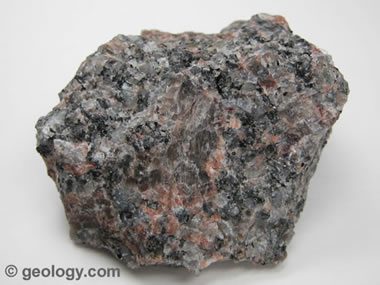
Granite: The specimen above is a typical granite. It is about two inches across. The grain size is fibroid plenty to let recognition of the major minerals with the unaided eye or with the help of a paw lens. The pink grains are orthoclase feldspar, and the clear to smoky grains are quartz or muscovite. The blackness grains can be biotite or hornblende. Numerous other minerals tin can be present in granite.
What is Granite?
Granite is a light-colored igneous rock with grains large enough to exist visible with the unaided eye. It forms from the slow crystallization of magma below World's surface.
Granite is composed mainly of quartz and feldspar with pocket-size amounts of mica, amphiboles, and other minerals. This mineral composition normally gives granite a crimson, pink, greyness, or white color with nighttime mineral grains visible throughout the rock.
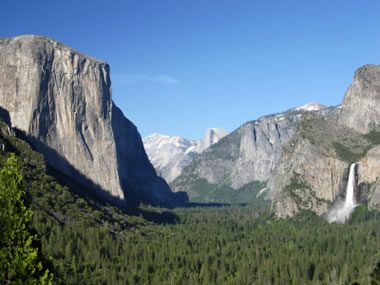
Granite in Yosemite Valley: Photograph of Yosemite Valley, California, showing the steep granite cliffs that class the walls of the valley. Image copyright iStockphoto / photo75.
Table of Contents
The Best-Known Igneous Rock
Granite is the best-known igneous rock. Many people recognize granite because it is the most mutual igneous rock establish at Earth's surface and because granite is used to brand many objects that they meet in daily life. These include countertops, floor tiles, paving rock, curbing, stair treads, building veneer, and cemetery monuments. Granite is used all effectually the states - especially if yous live in a large mod city.
Granite is also well known from its many world-famous natural exposures. These include: Stone Mountain, Georgia; Yosemite Valley, California; Mount Rushmore, South Dakota; Pikes Peak, Colorado; and White Mountains, New Hampshire.
Yosemite Nature Notes - Granite: This video examines some of the granites that create the breathtaking and climbing pleasures of Yosemite National Park.
Granite in the Continental Crust
Introductory geology textbooks written report that granite is the about arable rock in the continental crust. At the surface, granite is exposed in the cores of many mountain ranges, within large areas known as "batholiths," and in the core areas of continents known as "shields."
The big mineral crystals in granite are prove that information technology cooled slowly from molten rock textile. That boring cooling had to have occurred beneath Earth's surface and required a long menstruation of fourth dimension to occur. If these granites are exposed at the surface today, the only mode that could have happened is if the granite rocks were uplifted and the overlying rocks were eroded.
Most parts of Earth's continents are covered with sediments or sedimentary rocks. The rocks below are usually granites, metamorphosed granites, or closely related rocks. These deep granites are often referred to as "basement rocks."
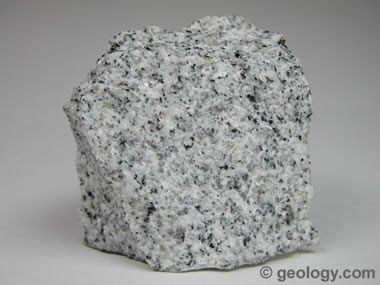
Granite: Photograph of a white, fine-grained granite. Many of the grains in this stone can be seen with the unaided eye - especially the black grains. However, the white grains are difficult to see with the unaided eye because their boundaries are difficult to recognize - fifty-fifty with help from a manus lens. This stone might be chosen an aplite because of its fine grain size. This specimen is about ii inches beyond.
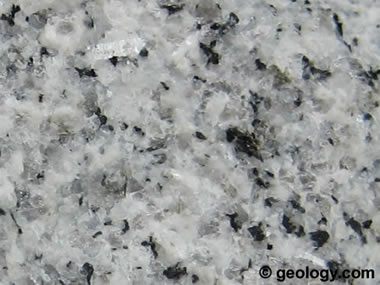
Granite close upwards: Magnified view of the white, fine-grained granite from the photograph above. You lot tin can see how information technology is difficult to recognize the boundaries between the lite-colored grains - even with the help of magnification. The surface area shown in this image is about ane/iv inch across.
Multiple Definitions of Granite
The discussion "granite" is used in a variety of ways by different people.
A simple definition is used in introductory geology or globe science courses.
A more precise definition is used past petrologists (geologists who specialize in the study of rocks).
And, the definition of granite expands wildly when used in the crushed stone and dimension rock industries.
These multiple definitions of granite tin lead to communication problems. However, if you know who is using the give-and-take and who they are communicating with, you tin interpret the word in its proper context. Three mutual usages of the give-and-take "granite" are explained beneath.
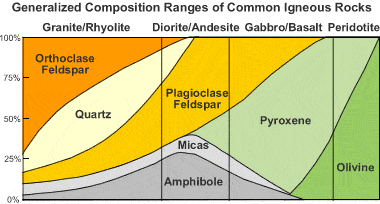
Generalized Composition Ranges of Common Igneous Rocks: This chart illustrates the generalized mineral composition of igneous rocks. Granites and rhyolites (compositionally equivalent to granite but of a fine grain size) are shown on the left side of the chart. From this diagram you lot tin tell: granites are equanimous mainly of orthoclase feldspar, quartz, plagioclase feldspar, mica, and amphibole; and, the orthoclase component can range in affluence from as little every bit 10% of the rock up to nigh 75% of the rock.
A) Introductory Course Definition
Granite is a fibroid-grained, calorie-free-colored igneous rock composed mainly of feldspars and quartz; information technology also contains minor amounts of mica and amphibole minerals (see the accompanying chart titled Generalized Limerick Ranges of Common Igneous Rocks). Once students know how to place the minerals in granite, this uncomplicated clarification enables them to identify the rock based upon a visual inspection.
During that visual inspection, students should apply a hand lens to ostend that the minerals of granite are present in the rock. That inspection would involve confirming that each of the minerals expected in granite is physically present in the rock - and present in the proper proportion.
Here is a summary of what you might detect on a cleaved surface of granite:
 | Did You Know? A Mitt Lens is an important tool for learning most rocks. The minerals in a stone must oft be identified to determine the rock'south name. |
Feldspar Minerals
Feldspar minerals are abundant in granite. They are usually white, gray, pink or reddish in color. Many grains will showroom two directions of cleavage that intersect at right angles. You should exist able to observe this cleavage pattern in granite with a mitt lens.
Quartz
Quartz will usually be a transparent mineral that is colorless or gray in color. Many grains will showroom a conchoidal fracture - with a vitreous luster on the conchoidal fracture surfaces.
Mica Minerals
The mica minerals expected in granites include muscovite or biotite. Micas occur in very thin sheets. They will often be in "books" of numerous sheets stacked upon 1 another. The surfaces of these sheets volition have a highly reflective vitreous luster. The edges of a "stack of sheets" volition wait like to the border of a stack of playing cards.
Amphibole Minerals
Amphibole minerals such equally hornblende are nighttime in color and will often take a prismatic addiction.
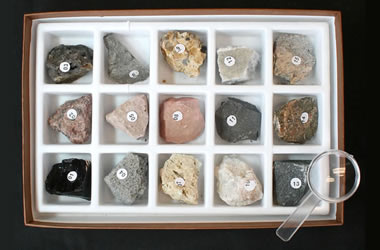
Rock & Mineral Kits: Get a stone, mineral, or fossil kit to learn more about Earth materials. The best fashion to learn virtually rocks is to have specimens available for testing and exam.
B) Petrologist'due south Definition
Granite is a plutonic stone in which quartz makes up between 10 and 50 percent of the felsic components. Alkali feldspar accounts for 65 to ninety per centum of the total feldspar content. Applying this definition requires the mineral identification and quantification abilities of a competent geologist.
This blazon of analysis cannot exist done precisely by a pupil in a classroom or a geologist in the field. This is an instance of the complexities that tin can be involved in assigning a formal name to an igneous rock.
Many rocks identified as "granite" using the introductory course definition will non be called "granite" by the petrologist. They might instead be alkali granites, granodiorites, pegmatites, or aplites. These names are for specific types of granite.
These names require a consideration of the grain size and the mineral composition of the stone - across determining that the rock is a granite. A petrologist might call these "granitoid rocks" rather than granites. At that place are many types of granite based upon mineral composition and texture.
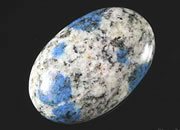 | Did You Know? Azurite Granite, also called "K2 granite," is often cut into gems. People relish its blue and white colors. |
The accompanying chart (Generalized Composition Ranges of Common Igneous Rocks) illustrates the range of granite compositions. From the chart you lot tin can encounter that orthoclase feldspar, quartz, plagioclase feldspar, micas, and amphiboles can each have a range of abundances.
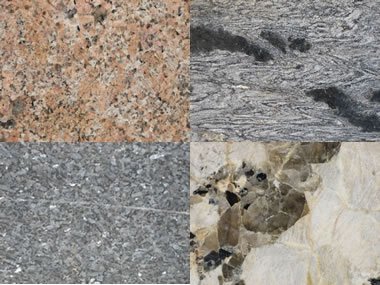
"Granite": All of the rocks in a higher place would be called "granite" in the commercial stone industry. Using the terminology of geologists, they would be (clockwise from peak left): granite, gneiss, pegmatite, and labradorite. Click on any of their names higher up for an enlarged view. Each of the images in a higher place represents a slab of polished stone about eight inches across.
C) Commercial Definition
Utilise of the word "granite" in the dimension stone and crushed stone industries is dissimilar from how the word is used by geologists. In these industries, the name "granite" refers to an igneous rock that meets the post-obit criteria:
one) a rock with visible grains that interlock with one another
2) a rock that is harder than marble
Using these criteria, gabbro, basalt, pegmatite, schist, gneiss, diabase, diorite, and many other igneous rocks volition be chosen "granite."
These "granites" are used to brand crushed stone that is used for highway construction, concrete, building construction, fill, railroad anchor, and many other purposes. They are used in the dimension rock industry to make countertops, floor tiles, curbing, building veneer, monuments, paving stones, and many other products. These granites might exist used with sawn, sheared, or polished surfaces.
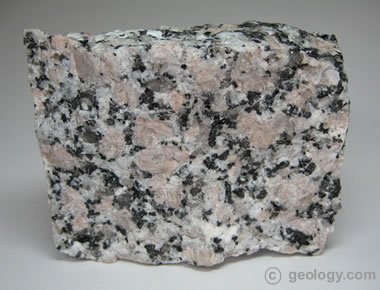
Pegmatite: Photograph of a granite with very large crystals of orthoclase feldspar. Granites composed mainly of crystals over 1 centimeter in diameter are known as "pegmatites." This rock measures approximately 4 inches across.
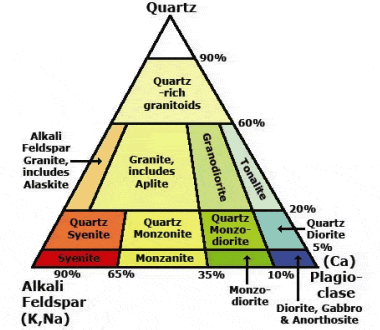
Granitic rocks: This triangular diagram is a classification method for granitic rocks. Information technology is based upon the relative abundance of feldspars (Chiliad-Na-Ca) and quartz. Mafic elements are not considered. It is modified after a classification chart prepared by the International Union of Geological Sciences. Epitome and modification past the United States Geological Survey.
When "Granite" Is Inadequate
So, the proper noun "granite" is a name used for igneous rocks that are composed of orthoclase feldspar, quartz, plagioclase feldspar, micas, and amphiboles that are nowadays in crystals big enough to be visible with the unaided eye.
That name isn't specific enough for some purposes and for some people.
Special names are used for granitic rocks based upon their grain (crystal) size. If a granitic stone has particularly big grains (over ane centimeter across), it is often called "pegmatite." If it is an especially fine-grained rock from crystallizing at a shallow depth, it might exist called "aplite."
Granitic rocks that take a mineral limerick that borders upon diorite might exist called "granodiorite." Those especially rich in plagioclase feldspars, at the expense of brine feldspars, might be called "monzodiorites."
The accompanying triangular diagram displays a classification method used for granitic rocks based upon the relative abundances of quartz, alkali feldspars, and plagioclase feldspars. This is not a chart for use past the beginning student of igneous rocks. It is a classification used by experts who have the skills and equipment needed to quantify the mineral composition of the stone.
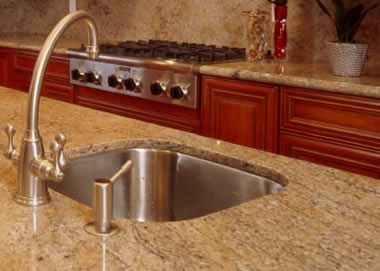
Granite Countertops: Granite countertops in a new kitchen. Image copyright iStockphoto / Bernardo Grijalva.

Mount Rushmore: Mount Rushmore in the Black Hills, South Dakota is a sculpture of United States presidents George Washington, Thomas Jefferson, Theodore Roosevelt, and Abraham Lincoln sculpted from a granite outcrop. Image copyright iStockphoto / Jonathan Larsen.
Uses of Granite
Granite is the rock most often quarried as a "dimension stone" (a natural rock material that will exist cutting into blocks or slabs of specific length, width, and thickness). Granite is hard enough to resist abrasion, strong enough to bear significant weight, inert enough to resist weathering, and it accepts a brilliant polish. These characteristics make it a very desirable and useful dimension rock.
Almost of the granite dimension stone produced in the United States comes from loftier-quality deposits in v states: Massachusetts, Georgia, New Hampshire, South Dakota, and Idaho.
Granite has been used for thousands of years in both interior and exterior applications. Crude-cutting and polished granite is used in buildings, bridges, paving, monuments, and many other exterior projects. Indoors, polished granite slabs and tiles are used equally countertops, floor tiles, stair treads, and many other practical and decorative features.
Loftier price often reduces the popularity of a structure material. Granite often costs significantly more than homo-made materials. However, granite is frequently selected because it is a prestige material, used in projects to produce impressions of elegance, durability, and lasting quality.
Granite is also used as a crushed stone or aggregate. In this grade it is used every bit a base cloth at structure sites, as an aggregate in road construction, railroad ballast, foundations, and anywhere that a crushed stone is useful as make full.
Discover Other Topics on Geology.com:
 Rocks: Galleries of igneous, sedimentary and metamorphic rock photos with descriptions. |  Minerals: Information about ore minerals, jewel materials and rock-forming minerals. |
 Volcanoes: Articles about volcanoes, volcanic hazards and eruptions past and nowadays. |  Gemstones: Colorful images and articles about diamonds and colored stones. |
 General Geology: Manufactures about geysers, maars, deltas, rifts, salt domes, water, and much more! |  Geology Store: Hammers, field bags, hand lenses, maps, books, hardness picks, gilded pans. |
 |  Diamonds: Larn almost the properties of diamond, its many uses, and diamond discoveries. |
Source: https://geology.com/rocks/granite.shtml
Posted by: smithwhossel.blogspot.com
0 Response to "What Is The Mineral Makeup Of Granite"
Post a Comment